Ebook Download Overall Equipment Effectiveness By Robert Hansen
By conserving Overall Equipment Effectiveness By Robert Hansen in the gizmo, the way you read will also be much easier. Open it and also start checking out Overall Equipment Effectiveness By Robert Hansen, straightforward. This is reason that we recommend this Overall Equipment Effectiveness By Robert Hansen in soft data. It will certainly not disturb your time to get guide. Furthermore, the online air conditioner will additionally ease you to look Overall Equipment Effectiveness By Robert Hansen it, even without going someplace. If you have link web in your workplace, residence, or gadget, you could download and install Overall Equipment Effectiveness By Robert Hansen it directly. You may not additionally wait to receive guide Overall Equipment Effectiveness By Robert Hansen to send out by the vendor in other days.
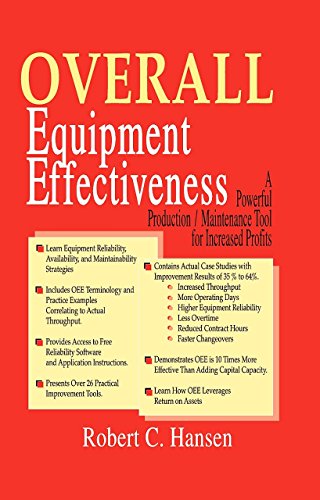
Overall Equipment Effectiveness By Robert Hansen

Ebook Download Overall Equipment Effectiveness By Robert Hansen
Do not make you really feel hard when searching for book that you will certainly review to save your time. Publication is always popular in each time, every era, and every age. All individuals will need book as referral to do something. When you have no concepts concerning exactly what to do in this leisure time, get Overall Equipment Effectiveness By Robert Hansen as one of the reference books that we provide! Offering special books are so pleasurable for us. It is so easy to offer kindness for everybody.
The visibility of this book is not only identified by the people in the nation. Many cultures from outdoors countries will certainly additionally like this book as the analysis source. The fascinating subject and also timeless topic become one of the all needs to manage reading this book. Overall Equipment Effectiveness By Robert Hansen also features the fascinating product packaging starting from the cover style and also its title, exactly how the writer brings the viewers to obtain right into the words, and also just how the author informs the material attractively.
From now, locating the completed website that markets the completed books will be several, however we are the trusted website to check out. Overall Equipment Effectiveness By Robert Hansen with very easy link, very easy download, as well as completed book collections become our excellent services to get. You can discover as well as utilize the advantages of selecting this Overall Equipment Effectiveness By Robert Hansen as everything you do. Life is consistently establishing as well as you need some brand-new publication Overall Equipment Effectiveness By Robert Hansen to be recommendation consistently.
Become part of those who love to read this publication. If you are the beginner reader, you can use this publication as temptation for you to minimally love analysis. Even this book is created by a specialist writer, it does not imply that the words are very hard to understand. You could take some lessons and also experiences from Overall Equipment Effectiveness By Robert Hansen based on just what you need. This is what calls as advantages of publication by reading. Currently, get this publication right here and also right now. It will certainly be offered in the site link to see.
- Sales Rank: #832360 in Books
- Published on: 2011-01-11
- Original language: English
- Number of items: 1
- Dimensions: 9.00" h x .70" w x 6.00" l, 1.10 pounds
- Binding: Paperback
- 256 pages
Review
"The book becomes a must-have desk reference for maintenance managers, production foremen, reliability engineers, manufacturing executives, and plant leadership teams." -- Bob Baldwin, Certified Maintenance Reliability Professional and Editor of Maintenance Technology Magazine
About the Author
Hansen received his BSEE from the Missouri School of Mines and his PhD from the University of Illinois. Since 1971 he has been a consulting engineer for antennas and system-related problems.
Excerpt. © Reprinted by permission. All rights reserved.
Leadership for Teams
Effective factories usually have coordinated teams that work synergistically with a common purpose. The teams, which are from all areas of the factory, have win-win relationships with their interdependent areas and services.
According to a panel of five reliability consultants at the year 2000 annual conference of the Society of Maintenance Reliability Professionals (SMRP), successful initiatives and programs are primarily driven from the top down rather than from the bottom up. In fact when asked, the panel couldn’t relate a single successful experience with a bot-tom up initiative unless it was first communicated to and accepted by the area leadership.
My own experience supports the concept that successful pro-grams can be implemented at the level of the ‘Champion’ on down. This can be seen where successful programs develop in one work center without ever transferring to other factory areas. When the person who championed the program leaves or transfers, all too often the work center does not sustain the high performance. However, the champions are able to generate new initiatives in other areas once they establish a rapport with the new community.
Management support and area leadership significantly influences the success of initiatives. To sustain a level of excellence, the total community--management, the line organization, and support groups--has to be of one mind. High performance work groups bridge the ‘top down’ syndrome by acceptance of synergistic team leadership.
Nearly everyone comes to work with a desire to do a good job and to be part of a successful unit. Your job and the security of your business depend on strong productivity and top effectiveness. Frustration comes when priorities are not clear and reinforcement is awarded inconsistently. Thus, a single metric--measuring the community as a whole-- can be powerful in bringing everyone together.
Let’s look at an example. I once facilitated a workshop activity aimed at improving the changeover time between orders for a packaging operation. This area had four similar flow-lines working around the clock seven days a week. The area had four shifts with four crews per shift, or a total of sixteen crews. Because each flow-line had two to ten changeovers per day, reducing the changeover time for the work area would greatly improve effectiveness. A workshop for developing quick changeovers using a methodology called Single Minute Exchange of Die(SMED)4 was selected for this task. SMED or quick changeover is cov-ered in section 8.3 of this book.
The operations manager decided to have one crew be the pilot crew that would go through the workshop and develop a best practice methodology. This approach proved to be more complex than expected. The area worked with approximately 130 different products, using 35 different processes. Many crews worked with more of one combination than another. Therefore, a typical changeover really did not exist.
In the workshop, the pilot crew categorized changeovers. They initiated improvements that reduced the majority of their changeover times by 40 percent. At the end of the pilot period they presented the results to the product line superintendent. Although they were proud to receive the superintendent's congratulations, they were shocked when he directed them to teach their methods to the other crews. They had not anticipated this directive, and felt that their reward was more work, beyond the original scope of the workshop. As a pilot crew, they synergistically made improvements, however other crews did not readily accept ‘outside’ ideas and passively committed to new methods. Thus, the improvement methods took much longer to be accepted by the other crews.
What actions would have been better? Proactive leadership would have led to faster results. When the operations manager initiated the request for improvement, he should have confirmed the efforts were supported by the superintendent and then communicated this to all crews. The overall objective should have been outlined with the strategy of how a pilot crew would be selected from volunteers, that this crew would make recommendations for best practices, and that all crews were expected to adapt these methods into their changeovers. If the results of the improvement were visible to the crews, and a system was developed to reward the community when the average changeover improved, then the methods would have been implemented quickly. The superintendent should have invested three or four hours of proactive leadership, earning the support of all the crews. By clearly communicating the desired goal and the expectation that everyone will help implement improved work practices, proactive leadership would provide the community with a com-mon vision. This style of leadership and communication open the way for rapid implementation and sustain improved practices.
Proactive leadership is a vital part of developing work place improvements. It can start at any level of the organization. As objectives are selected, approval should be solicited from the area leadership team to clear the way for rapid success. This book should provide the tools to generate compelling programs for higher effectiveness.
Overall Equipment Effectiveness
By Robert Hansen PDF
Overall Equipment Effectiveness
By Robert Hansen EPub
Overall Equipment Effectiveness
By Robert Hansen Doc
Overall Equipment Effectiveness
By Robert Hansen iBooks
Overall Equipment Effectiveness
By Robert Hansen rtf
Overall Equipment Effectiveness
By Robert Hansen Mobipocket
Overall Equipment Effectiveness
By Robert Hansen Kindle